
 Login / Register


Vintage 2025 Growing Season
The winter months of 2024/5 were mild and relatively uneventful, yet the legacy of the previous year’s exceptional rainfall would have a decisive effect on the 2025 vintage. The saturated subsoils left behind by the high rainfall of 2024 acted as a natural reservoir, providing the vines with precious water reserves as Bordeaux entered what would become an early, hot and particularly dry growing season. From the outset everything moved very quickly. Bud break was recorded around the 27th March, some two weeks ahead of the seasonal norm, and with little frost pressure to impede progress there was an immediate sense that the vintage would be an early one.
April brought welcome rains, which replenished the surface soils and proved invaluable given what was to follow. Thereafter the weather changed dramatically. May was warm, dry and settled with temperatures reaching 30°C during the flowering on the 13th and 14th. The result was a rapid and homogeneous flowering, with little disease pressure and almost none of the mildew concerns that so dominated the previous campaign. However, the challenging flowering conditions of 2024 had already left their mark. Many vines entered the season carrying fewer bunches, and berry numbers were naturally reduced. The Châteaux knew early on that yields would be modest at best.
June and July were characterised by persistent heat and drought. Water stress arrived early, slowing the vegetative cycle before véraison and limiting berry size. The bunches remained small, healthy and thick skinned, producing grapes of intense concentration but with very little juice. It is no surprise that comparisons have been drawn with 2003 and 2022, all three vintages experiencing more days above 35°C than any others this century. Yet 2025 appears to have retained greater balancing freshness than either 2003 and 2022, thanks in no small part to the rains that arrived from the 28th August into early September, lowering temperatures, boosting the juice and allowing the vines to complete ripening at a steadier pace. Just as importantly, the cooler nights of September helped preserve acidities and checked rising alcohol levels. These late summer rains may well define the success of the 2025 vintage.
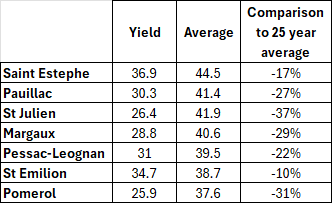
Harvesting began very early, with dry whites picked from mid August and the reds following in early September, many Châteaux recording their earliest harvest on record. Volumes are the smallest since 1991, around 15–20% below the five-year average. Organic producers often fared well, their cover crops helping soils retain moisture through the summer drought.
The following table shows the yields by appellation in 2025;
Vintage 2025 – The Wines
The wines we tasted during our Châteaux visits and Union des Grand Crus tastings during the week of 22nd April showed excellent ripeness, concentration and intensity. No surprise, given the hot and dry days during the summer of 2025. What we weren’t expecting was the wonderful freshness and impressive natural balance that they displayed.
2025 was a vintage of extremes with heat and drought the central pillars. Yields were small in all appellations, yet, as so often happens in Bordeaux, something happens! In 2025 it was the late summer rains at the end of August and early September. Those that waited for these rains have produced wines that possess a remarkable precision, purity and poise. In many respects, 2025 is a triumph of restraint in both vineyard and the cellar.
This was not a year for exuberant winemaking or heavy extraction. The berries were naturally small with thick skins, little juice and a strong tannic content. Gentle handling was everything. “Less is more” became the mantra in many cellars, with soft infusion replacing forceful extraction. The best wines are not hulking caricatures of power, but judged expressions of concentration and balance. Fermentation choices were similarly restrained prioritising purity over extraction and allowing terroir to emerge with unusual transparency and definition throughout.
The revelation of the vintage is its freshness. One might have expected the heat to bring high alcohols and overblown, concentrated, low acidity wines. Instead, many estates produced wines that show an invigorating acidity, lower pH and moderate alcohols that deliver energy and definition. Deep in colour and rich in structure, they are vivid and composed rather than heavy. This has resulted in wines that feel surprisingly lifted on the palate despite their underlying density and concentration.
Stylistically, 2025 recalls 2003 yet with the freshness found in both 2016 and 2023. It is a curious combination. Muscular wines, but polished rather than austere. The tannins are abundant yet silky, the fruit profiles are a blend of both black and red fruits, resulting in an immediacy and drinkability not always seen in concentrated vintages. There is a clarity of expression across the best estates that speaks to careful vineyard selection and precise harvesting decisions.
So what of the Left Bank? In the Médoc, the old Cabernet Sauvignon vines with deep roots were the stars of the vintage. Able to search for water reserves, they handled drought with composure and produced serious structured wines with excellent ageing potential. The younger vines struggled in the parched soils and lacked equilibrium. This disparity has highlighted once again the importance of old vines in mitigating climatic stress across the region overall.
There were local variations. Saint-Julien suffered from lack of water but this appellation has performed particularly well and we tasted some particularly impressive wines. In Margaux, no meaningful rain fell between 10 June and 25 August, testing the growers, yet where vineyard management was astute the results are excellent, with fragrant Cabernet fruit and finely etched tannins. At Château Angludet the decision was to wait for the forecast rains in early September to boost the tiny berries. The vines absorbed moisture, the grapes gained juice, and the resulting wine is quite terrific – patience rewarded!
In northern Pauillac, timely 25–30mm rains in mid June and mid July preserved balance and some excellent wines were produced. Such variability underscores the increasingly fragmented nature of Bordeaux vintages under extreme weather conditions, where microclimate and timing can determine success or failure.
On the Right Bank, Pomerol and Saint-Émilion excelled. The Merlots grown on clay soils thrived, producing plush aromatic wines. The blue clays of Pomerol conserved moisture and preserved freshness. Yields were very low especially in Pomerol. Édouard Labruyère of Château Rouget called organic farming …”a nonsense”, given yields of just 22hl/ha. The contrast between clay and gravel soils was particularly evident this year, reinforcing long held understanding of terroir sensitivity in hot dry vintages across the Right Bank as a whole regionally.
The dry whites have performed very well once again. The Sauvignon Blancs delivered citrus freshness and floral lift, whilst the Sémillon added texture and waxy richness. The best combine tension and generosity and will give early pleasure, though the top cuvées will age very well. Several Châteaux commented that these wines may surprise in bottle with greater longevity.
Sauternes and Barsac produced wines of distinction. In a warm year, fears of heaviness were avoided and noble rot developed steadily. The finest examples balance botrytised richness with vibrant acidity, sweet but not cloying.
In conclusion, 2025 is a very good vintage overall. Selection is always the key, but that is our job! Small yields have delivered wines that are concentrated with exuberant red and black fruits that also show a surprising freshness and balance for such a hot vintage. The best wines are precise, fresh with a real terroir transparency. Structured for ageing yet polished enough to enjoy young, it is a modern Bordeaux vintage with classical balance. It also reflects a broader trend towards finesse driven Bordeaux, even in seasons defined by climatic extremes.
 Back to blog